The plight of Hungary
Austria-Hungary fought on Germany’s side during the First World War. After the Dual Monarchy had dissolved, Hungary experienced two revolutions and invasions by foreign troops. Moreover, in accordance with the Treaty of Trianon (4 June 1920), Hungary lost two-thirds of its territory to (new) neighbouring countries. As a result, almost half a million Hungarians, having become minorities in Czechoslovakia, Romania and Yugoslavia, migrated to Budapest and other large cities in the Hungarian heartland. There they were confronted with sky-high inflation, unemployment, poor housing, and food shortages.


The organisation
The Netherlands had already been taking in Hungarian children for a few years when, in 1923, the Hongaarsch Kinderwerk (Hungarian Work for Children) was founded. This was a Catholic initiative supported by the Belgian Cardinal and Archbishop Mercier. Besides the national secretariat in Turnhout, several local committees were also established, with the purpose of generating interest in the project among potential foster parents. Parish priests used the pulpit to convince their congregations to foster a child. At the same time, the Hungarian National Child Protection League in Budapest took responsibility for the selection, medical examination and departure of the children.


To Belgium!
Between 1923 and 1927, more than forty trains filled with children left from Budapest’s Keleti railway station for Belgium. They brought 20,000 children all over Flanders, and to a lesser degree Wallonia. The children arrived with identity cards in their pockets and identity tags around their necks. These were used by foster parents to find ‘their’ child.


The stay
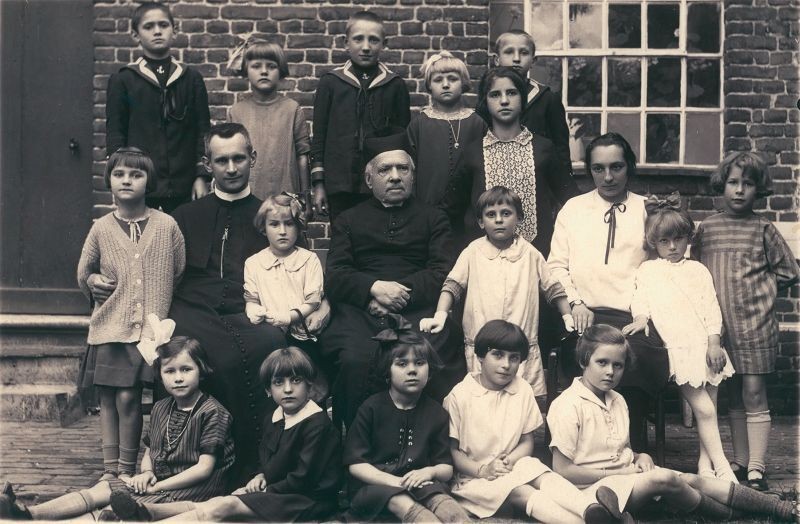
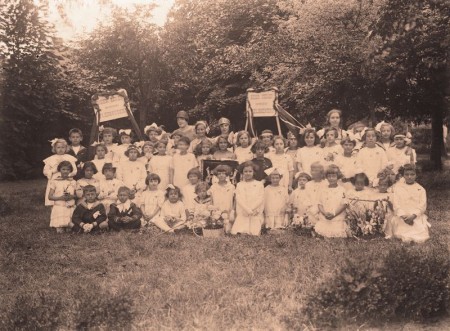
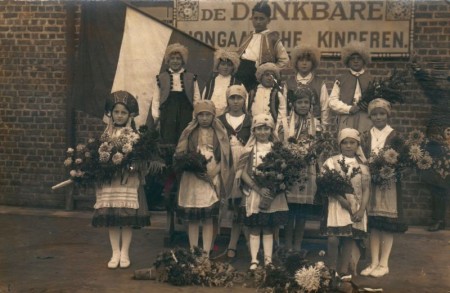
The children were hosted in many kinds of households: young families with their own children, childless couples, single women, cohabiting siblings, convent sisters and parish priests. In order to facilitate conversation, special dictionaries were circulated. The children attended school, made their First Holy Communion, and were used in publicity for the Child Relief Project. Meanwhile their families in Hungary were very far away. Home was tangible only in letters and photographs.


Return?
According to official guidelines the stay was to last only six months, but in practice many children remained longer. Such extensions required the permission of the Hungarian parents. Some children came back to Belgium multiple times. There were others who never returned to Hungary, for example, because their parents could no longer care for them. In 1927, Hungary ended the project, but so-called holiday trains continued to travel between both countries. In the 1930s, those who had remained in Belgium looked each other up, and, if possible, visited their homeland. While they retained their Hungarian identity, at least partially, their lives took shape in Belgium.


The Hungarian National Film Archive holds two newsreels about the return of children from Belgium at Budapest’s Keleti railway station (1926): newsreel 1 and newsreel 2.
Other child relief projects
The Hungarian children were neither the first nor the last group of foreign minors who were sheltered by Belgium in the interbellum years. Austrian, Russian, and Spanish children, among others, also came to stay (temporarily) in Belgium.


Austrian children
The Austrian child relief project can be seen as a sort of unintentional practice run for the Hungarian Work for Children. In both cases, the children came from the former Dual Monarchy, the socioeconomic situation in their home countries was comparable, and the network in Belgium was much the same. Nevertheless, Belgians were not initially enthusiastic about hosting Austrian children. Was the Great War still too fresh in the national memory? However, in 1921, the Bishop of Liège, backed by Cardinal Mercier, became involved in the project. In total some 1,000 (predominantly Viennese) children came to Belgium, most temporarily, but others permanently. With the tentative economic recovery of Austria from 1923, the relief action ended.
Russian children
After the Communist Revolution of 1917 and the ensuing civil war, hundreds of thousands of Russians fled their country. Many ended up in Constantinople. Fearing political repercussions, the Belgian Government did not want to become involved in an official capacity with these refugees but did, however, leave room for private initiatives. One such initiative was the Œuvre de secours aux enfants russes en Belgique, which brought Russian children to Belgium. These children were sent to live not with host families but in so-called children’s colonies. Another 200 orphans followed later, along with the boys from the Collège Saint-Georges boarding school.


Boys from the Collège Saint-Georges boarding school in Namur (1922).
The Spanish Civil War, which started in 1936, threatened thousands of niños de la guerra. In Belgium the Socialists launched a call for host families and by the summer some 1,200 Basque children had found a new home. Concerned that children might lose their faith while in leftist families, Catholics launched a network of their own, which provided shelter to approximately the same number of children. At the end of the war in April 1939, the campaign was ended. Most of the children returned to Spain, but some continued to live in Belgium.
The second Hungarian child relief project
At the end of the Second World War the plight of children across devastated Europe attracted more attention than ever from the international community. Caritas Catholica sent clothing and food from Belgium to Germany, Austria, Hungary and other countries. At the same time, starting in 1946, they again organised temporary homes for children in Belgian host families. In Hungary, they cooperated with Actio Catholica on this project. When the Communist Party took power two years later, the project was ended. A mere 1,000 children had been able to avail of it. Once again, some remained in Belgium for good.


Colophon
This online exhibition is based on the exhibition that KADOC organised in Leuven in 2016.
With our thanks to all those who loaned material for this exhibition.
More information?
Respond to the exhibition
Noticed something unusual or have a story to tell about this item? Share your thoughts below.
Also interesting for you
This story is only the beginning. Keep exploring related stories, collections and exhibitions.

