Polish labour migration to Belgium and the trade union movement - Mirte De Visscher
People of Polish origin live all over the world, having migrated for many different reasons. This Polish diaspora is known as ‘Polonia’ and there is also a large Polish community in Belgium. In 1950, there were already more than 60,000 Poles living in Belgium and they were active in various areas of society. After the Second World War, Poles formed a substantial part of the workforce in the mines.

After a century and a half of division among various powers, Poland was an independent state again after the First World War, but with many economic problems. There were also several conflicts with the surrounding countries during the interwar period. The living conditions were far from ideal. During the Second World War, Poland was occupied by Germany and the Polish government fled to London. In 1945, the Red Army expelled the Germans and the communist Polish United Workers Party came to power.

Migration to Belgium and the mineworkers
The migration of Poles to Belgium started in the nineteenth century, but became more systematic after the First World War. The ‘old’ Polish migrants came to Belgium because of the great demand for labour for the Belgian coal mines and the poor economic situation in Poland. After the Second World War, migration accelerated. The demand for labour in the mines increased further and many Poles fled the communist regime in their homeland. Among the miners recruited, there was a large number of Polish Displaced Persons, who had been deported to Germany during the war and could not return to their homeland.


The working conditions in the mines, both during the interwar period and after the Second World War, were absolutely not pleasant. In Walloon collieries, many of the migrants lived in so-called ‘canteens’, large dormitories without any form of privacy. In the Limburg mines, the Polish miners could live in ‘garden suburbs’. These areas were specially built for the miners with open buildings and lots of green.
Yet the situation was far from ideal. The Polish workers suffered more accidents than the Belgian miners, because they had to do more dangerous work. In addition, the wages of Polish miners were lower than those of Belgian ones. The economic crisis in the 1930s provoked several strikes, of which migrants were twice the victims. The trade unions demanded that all foreign miners should be fired, in favour of the Belgian ones. In addition, Poles who engaged in social protest were ordered to be deported.
The need for trade unions and creation of the Polish Section
The situation for Polish miners was miserable and they had no representation at the trade unions. This changed after the Second World War. By then, Polish workers made up about 10% of the miners. This made them an important source of new members for the trade unions. Both the ABVV-FGTB and the ACV-CSC started to focus more on Polish migrants. The Poles themselves also benefited from a trade union that defended their interests. This made it possible to improve their working and living conditions.

In 1947, the Polish-Baltic section of the ACV-CSC was founded. The Flemish section was led by F. Galazka and the Walloon by F. Krakowski. They travelled throughout Belgium to recruit members. The ABVV-FGTB was much less active for the migrants and only had sub-sections within the existing organisation. The socialist trade union had to deal with the different socialist and communist ideologies among the migrants, which were not compatible.

The ACV-CSC supported the migrants in various ways. On the one hand, the ACV-CSC defended the interests of Polish workers. In case of strikes, Polish members got their wages paid from the first day. With the ABVV-FGTB, this was only from the third day of a strike. On the other hand, the ACV-CSC also paid much attention to the associative life of Poles and to Polish culture. Together with the Catholic organisations RMK (Robotnicza Mlodziez Katolicka / Catholic Workers’ Youth) and SMK (Sto warzyszenie Mężów Katolickich / Society of Catholic Men), the ACV-CSC organised a wide range of activities.


Polish associational life
The Polish migrants were a very heterogeneous group, but the Catholic faith was something that united them. At the catholic level, there were several initiatives through which the ACV-CSC got a foothold among the Polish migrants, in contrast to the ABVV-FGTB. Thus, visits by priests were organised in the mining communities. The Sto warzyszenie Mężów Katolickich / Society of Catholic Men (SMK), with which the Polish section of the ACV-CSC worked closely, endeavoured to appoint priests in the mining committees who could speak Polish. Regular pilgrimages to Scherpenheuvel and Lourdes were also organised.

The SMK and the ACV-CSC were together very active in organising education for Polish migrant children. They jointly founded the Central School Committee (CKS), which was soon renamed Polish School Mother (PMS). In 1955 they established 46 schools, employing 27 teachers and educating 1027 children. A central figure in Polish education was E. Pomorski, who was appointed school inspector in Belgium by the Polish government in exile in London and thus the anti-communist camp. The schools were also a way of ensuring that the second generation did not lose touch with their homeland. This was done by teaching in the Polish language and including important Polish culture and history in the lessons.
The Polish section of the ACV-CSC also had its own press. This was an important element in getting the migrants involved in the trade union movement. The first Polish trade union press, Życie i Praca ('Life and Work'), was published in 1947. The periodical was succeeded by Przy Pracy, a literal translation of the French-language periodical Au Travail published by the ACV-CSC. From 1965 to 1981 Praca, Monthly Organ of Polish Workers in Belgium, was published. The periodical mainly focused on workers and the problems and topics that concerned them. Many articles dealt with wages, holiday arrangements, social security, etc. Catholic subjects were also covered quite extensively.


The Polish crisis in the early 1980s, the ACV-CSC and Solidarność
In the 1970s more and more Poles began to oppose the communist regime and underground protests and strikes occurred. Towards the end of the 1970s the trade union Solidarność was formed, which received support from the Roman Catholic Church and many intellectuals. Solidarność gained more and more supporters and the opposition movement grew. In 1981, a coup d'état took place under pressure from the Soviet Union and Solidarność was banned along with other opposition movements. Despite the ban on Solidarność, the union continued to exist underground and gained support at home and abroad.

The situation in Poland did not leave the minds of Poles in Belgium unmoved. In December 1981, Praca devoted an entire issue to the events in Poland, in which the official reactions of the ACV-CSC and that of the Labour Federation were reported, as well as a text by Lech Walesa, the leader of Solidarność. Initially, the ACV-CSC offered mainly moral and logistic support by organising protest demonstrations and hosting Solidarność representatives. It was only when Walesa appealed for food for Polish workers that more concrete initiatives got off the ground. The ACV founded the organisation The Solidarność Belgium Action Committee (Komitet Działania Solidarność Belgia) and paid part of the wage costs, together with the ABVV-FGTB. Through this organisation, huge sums were collected for humanitarian aid.

The driving force behind the humanitarian aid from the ACV-CSC was Tadek Oruba, the chairman of the Polish Section. Following his plea for co-ordinated action, the National ACV/CSC Poland-Solidarność Commission was established in 1985. In 1986 it launched a campaign that later proved to be its most important achievement: helping to organise summer camps for 2,000 children from the province of Lublin. Oruba himself organised convoys of humanitarian aid to Poland; he was involved in 41 actions between 1982 and 1985.
The birth of Czechoslovak Scouting in the Netherlands - Miroslav Michela and Michaela Šmidrkalová
Today’s Junák – Czech Scouting is the largest non-formal educational NGO for children and youth in the Czech Republic with high-quality facilities and aspiration to keep its history alive. High importance is still attached to the memory of the movement’s resistance against two undemocratic dictatorships – the Nazi and Communist rule.
However, exiled Czechoslovak Scouting is a relatively little-known phenomenon today, but for many Czech and Slovak émigrés it remains the source of beautiful memories. It was a way of bringing people together and get closer to nature, maintaining the unique Scout and national identity.

Czech Scouting and the Junák movement
The Czech Scouting and Junák movement began its activities after 1911, led by Antonín Benjamin Svojsík, who was inspired both by the British scouting movement of Robert Baden-Powell and the tradition of forest wisdom (woodcraft) by Ernest Thompson Seton. In contrast to the Scout movement abroad, the Czech Scout movement was not based on religious roots.
The organization of Scouts in Czechoslovakia was disbanded three times in the 20th century (1940, 1950, 1970) for ideological reasons and experienced a lengthy persecution by Nazi and Communist regimes in the 20th century. After the Nazi occupation of Bohemia and Moravia, scouting was suppressed and banned, and many Scouts were active in the anti-fascist resistance movement. After the end of World War II, scouting experienced a boom, reaching some 250,000 registered members. However, after the communist coup in 1948 they become a target of repression, and Scout leaders and several members were tried. Scouts were gradually snuffed out through forced integration into their communist equivalent – Young Pioneers.


The Czechoslovak time of exile
There were two major migration waves towards the West because of the political changes in Czechoslovakia, which had a significant impact on the development of the exiled Czechoslovak Scout movement. The first one was after the Communists gained power in 1948. The second one followed the violent suppression of ‘The Prague Spring’ and liberal tendencies in the country. Subsequently, the so-called ‘normalization’ in the country brought a ban on Junák in 1970, and any activities organized for youth were again fully subordinated to party control.
Many Czechs and Slovaks who had left their homeland became involved in various fraternal and exile organizations abroad and participated in the preservation of national customs and culture.


Velen Fanderlík
The last elected chairman of Junák in Czechoslovakia and a chairman of exiled Scouts, Velen Fanderlík was from a family of Dutch origin and was forced to escape Czechoslovakia twice during his life. During World War II, Fanderlík helped Czechoslovaks fleeing Nazi-occupied Bohemia and Moravia get to France. After studying law in England, he was part of the team that prosecuted Nazi war criminals in the Nuremberg trials. After the war, he returned to Czechoslovakia, but was forced to escape into exile again in 1947 because the secret service planned to arrest him.
Fanderlík and his colleagues founded an exile Czechoslovak scouting magazine called Skautská stopa ('Scouts’ trail'). Later, he wrote several scouting handbooks in Canada and sought to re-establish the organization in some form under the uneasy conditions of the Cold War.

Czechoslovak exile in the Netherlands
Although the countries of today’s Benelux were not among the main destinations of Czechoslovak exiles in the second half of the 20th century, many of the exiled found their new home in the Netherlands. In November 1949, the number of expatriates in the Netherlands was estimated at around 200 people, in 1973 at 900 people, and in 1980 at around 1,000 people. It is noteworthy that in terms of professional composition, students and scientists were relatively well represented among the emigrants, which was related to the financial support from the Dutch government. Many of them became doctors.

Bringing together the Scouts in exile
Together with Josef Kratochvíl (J. K. Baby), Fanderlík founded the Preparatory Headquarters for Czechoslovak Exile Scouting. In 1968, armed forces of the Warsaw Pact invaded Czechoslovakia, and afterwards there were enough people to establish the movement as there were many active Scouts among those hundred thousand migrants.

n the 1970s, the émigrés began forming their own groups in the countries where they now had their refuges. These small and isolated groups united in 1975. There were active units in Switzerland, Germany, the Netherlands, and Austria. At its heyday in 1985, there were 11 Scout troops in Western Europe, counting nearly four hundred active members.
Before 1989, the members of Czechoslovak Exile Scouting organized four international meetings (Exiloree) for the members and guests and participated in various international meetings abroad.


Skauted publishing house in Netherlands
Publications by the Skautská edice (Skauted) special publishing house founded by the organization’s leaders in 1975 were an important source of information and inspiration. Skauted was run mainly by Dr. Tibor ‘Cipa’ Grantner, a senior leader of Slovak origin who lived in Utrecht and Nijmegen and published various books and printed materials, mostly handbooks and manuals, but also the magazine Šíp ('The Arrow'), containing comics and printed in 400 copies, as well as adventure books for Scouts.


Dr. Ctirad ‘Radek’ Kučera from the Netherlands was one of the most active writers and painters. He wrote several books for young Scouts and produced a popular publication accompanied with cassette tape called Rohlík (Roverská hudebně literární kazeta / Musical and literary cassette for Rovers) dedicated to the preservation of Czech cultural awareness and linguistic competence.


The end of exiled Scouting?
The political changes in 1989 brought about an impact on the exile and all kinds of exile organizations, many of which had to close. Exiled Scouts changed their name after the revolution to Czech and Slovak Scouting Abroad. Gradually, with the rehabilitation of Scouting in the Czech Republic and ever fewer children aboard, the camps in Western Europe began closing one by one.
The problem with recruiting new members and large distances between the memberships was noticeable already before the Czechoslovak Velvet Revolution. In 1987, the ‘Area Netherlands’ was forced to close for these reasons and the remaining activists merged with their Swiss counterparts.
Despite these changes, there are still active Czech and Slovak Scouts in the West who still maintain common activities today. The heritage of exiled Scouting in the Czech Republic is also maintained by such institutions as the Scouts Archive and the library Libri Prohibiti.


The Polish Catholic Mission of Brussels: pastoral care for a migrant community - Elżbieta Kuźma
Among Polish institutions and organizations in exile and performing activities in Polish communities, the Polish Catholic Mission should be mentioned above all. In the case of Poles living in Belgium, for whom the Polish Catholic Mission is not only a parish and a place of religion activities, but also - as they say – ‘a substitute of the Homeland’ or ‘Poland in miniature’. It is also a unique bridge connecting two communities, Polish and Belgian, which have been living for almost two hundred years on one common land.

The origins of the Polish Catholic Mission and the arrival of the Second World War
Despite the large number of Polish immigrants established in Belgium, which dates back to the period of the Great Emigration and exile from Polish lands initiated by the participants of the November Uprising of 1830, for nearly a hundred years there was no permanent and regular pastoral care available in the Polish language. Only in January 1926, thanks to the efforts of the then Polish Primate August Hlond, and with the consent of Belgian Cardinal Désiré Joseph Mercier, was the Polish Catholic Mission in Belgium established. Its purpose was providing pastoral care for Polish immigrants living in Belgian lands. A year after, the scope of activity was extended and included also The Netherlands and Luxembourg.
During World War II, the German occupiers did not agree with conducting pastoral care in Polish, so Polish priests were forced to celebrate masses in particularly difficult underground conditions. After the war, when more Poles came to Belgium – former prisoners of German concentration camps, as well as former soldiers of the Polish army fighting alongside the Allies – a need to develop the pastoral care of the Polish diaspora in Belgium arose, requiring an increase in the number of priests serving among the faithful from Poland. In order to ensure permanent and more developed pastoral care for a large number of Poles, Cardinal Hlond, entrusted the pastoral care of his compatriots in Belgium to the Congregation of Oblates on January 1, 1948, which resulted in an increase in the number of priests to twenty, and a dynamic development of religious, educational and social activities.
Religious, educational and social activities
The Polish Catholic Mission, which was - from the beginning - a church organizational unit, was responsible for the organization and development of the religious life of the Polish immigrants living in the Kingdom of Belgium. The pastoral activity of the Mission was the same (and remains so today) as that of any parish in Poland and included, among other duties, celebrating services, administering the sacraments, and so forth. The role of Polish priests living in exile was, however, much broader and goes beyond traditional pastoral activity. For nearly a hundred years, Polish priests serving in Belgium organized not only religious, but also educational, cultural, social and national life in exile.

The native language, history, geography and Polish culture were taught in the operating church schools. Numerous associations and folklore groups were active in the parishes, newspapers were published in Polish and important national events were celebrated. Polish priests were not only spiritual guides for their compatriots, but also teachers, translators and social workers. This last role was particularly important in the period preceding Poland's accession to the European Union, which gave Poles the legal right to stay and work in Belgium. Most of the Polish émigré community gathered around the parish, for which the Polish Catholic Mission became a home substitute, in which rescue is sought, among other things, in difficult moments of life.
From ‘Mission’ to ‘Community’
Despite the many years that have passed, the importance of Polish pastoral care in Belgium is still significant. To this day, the Polish pastoral ministry is a centre of religious, cultural, educational and social life, which unites Poles living in Belgium. The Polish Catholic Mission, renamed in 2018 by the decision of the Belgian Bishops’ Conference to the Polish Catholic Community, still plays an important role for Polish émigrés, despite the deepening of their roots on Belgian soil, and is still referred to as the Polish Catholic Mission or just ‘the Mission’ by the members of the Polish community.


Among the religious activities carried out by priests from the Polish Catholic Mission, it is worth mentioning the pilgrimages to shrines in Belgium organized for Polish emigrants. Annual trips to Scherpenheuvel (Montaigu), in the Flemish Brabant region, and Banneux in the province of Liège, have been a permanent element in the pilgrimage program of the Polish Catholic Mission for years. Apart from the religious aspect of these trips, they play an important role in familiarizing the community with their adopted homeland. They are an excellent opportunity to visit places important to Belgian Catholics (Banneux is the site of Marian apparitions, recognized by the church) and to take part in local celebrations. The Sanctuary of Banneux is a place of ecumenical activity, a meeting place for various groups of Christians from different countries. In a more recent sign of incercultural contact, it has also become a place where representatives of the Muslim community regularly appear.
The Mission’s place in Belgium
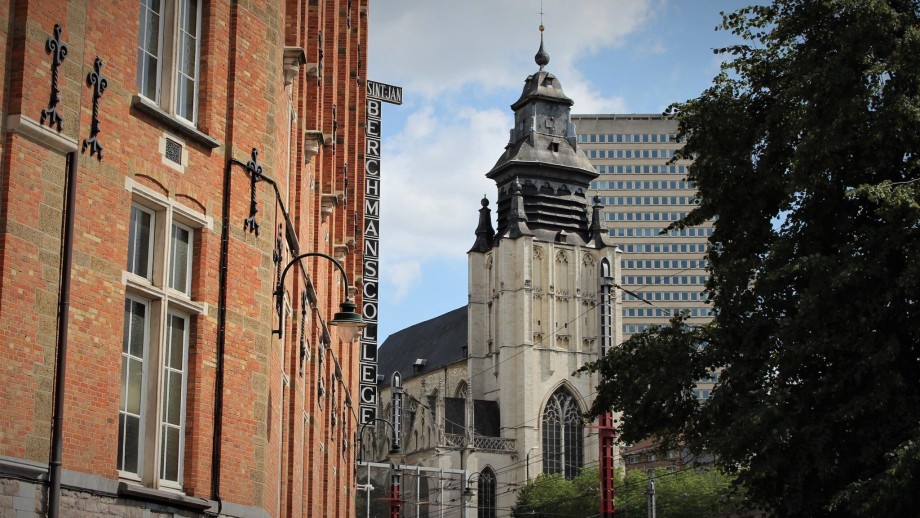
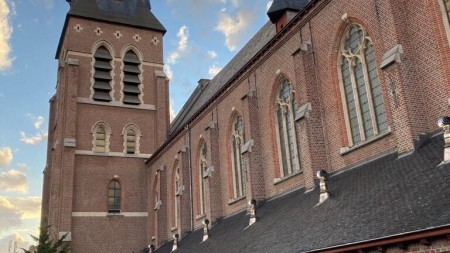
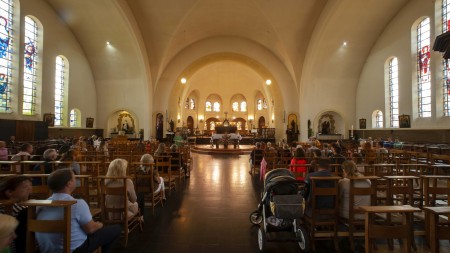
The importance of the Polish Catholic Mission in the Polish migrant community is well known to Belgians, both among ordinary citizens as well as the Belgian authorities and administration. Of course, church authorities are also aware of its role. It is thanks to their support that the Polish community is made available to other churches in Brussels, where services are held in Polish on Sundays and holidays. Thanks to the size of the Polish migrant community, the strong attachment to the religion of their ancestors and thus a significant participation in Sunday and holiday services, incomparably greater than in the case of the native Belgians, it can be said that the activities of the Polish Catholic Mission or the Polish Catholic Community revived the deserted churches of Brussels. More and more services in Polish, attended by hundreds of believers, have helped the church of Notre-Dame de la Chapelle in the centre of Brussels, the church of Sainte-Elisabeth in the Schaerbeek district, or recently, the church of Saint-Joseph in the Anderlecht district, regain their former character, boasting regular attendees, and the parishioners – thanks to contributions and donations for holy masses – contribute to bearing the burden of utilities and building maintenance. That means that thanks to the Polish migrant community, some churches in Brussels have been saved from total neglect or even closure.

Carlos Bressers and the question of ‘Polishness’ in Cold War Ghent - Luke Dodds
For Central and Eastern European émigrés during the Cold War, a good reception by the West was no guarantee. In many walks of life, these exiles ingeniously employed the society around them to relate to their new homes and exercise their cultural and political voices there. For many newcomers in Belgium, religion served to cushion their arrival. The clergy of the Catholic Church – on many levels fervent supporters of anti-communism and the rights of these émigrés – were happy to oblige, and for the Polish and Hungarian communities of Ghent in East Flanders, one priest stood out as a human ‘bridge’ to welcome these people to Belgian society and preserve their unique identities and opinions in a foreign land – Carlos Bressers.


Carlos who?
Carlos Bressers was born 6 September 1912, the youngest son of the religious mural painter Léon Bressers and his wife Marie Bressers-Woestenbergh. Coming from a prominent Gentenaar family of church artists and architects (his grandfather, Adriaan, and oldest brother, Adrien, respectively) as well as clergymen (his older brothers Jozef and Leopold), the Bressers entwined creativity and religion in their work – and Carlos would be no exception.
In childhood, Bressers had his first fateful encounter with Eastern Europe, when his family hosted his ‘sister’ Sára ‘Sari’ Gáspárdy, a young Hungarian girl, as part of the Hongaarse kinderacties of the 1920s. Hundreds of Hungarian children were temporarily fostered by Belgian families. Sára's sister was also brought to Belgium by the project, but it is not clear whether she stayed with the Bressers family as well.
Sára and Carlos remained in contact throughout their adult lives, and her childhood stay in Belgium seems to have been a somewhat formative experience for Bressers’ dedication to Central and Eastern European migrant communities.


The arrival of the Eastern Europeans
Gáspárdy – a Hungarian – would have been an uncommon sight in a city such as Ghent in the 1920s, when most of the Eastern European migrants in Belgium were still concentrated in the mining regions of rural Limburg. Immigration had occurred since the nineteenth-century, when countries such as Poland and Hungary were fractured by economic problems, territorial divisions, and war. Choosing the call of religion over working in the family atelier, Bressers studied theology and was appointed a priest at Ghent’s Sint-Baafs Cathedral in 1942 and by this time, the distance between West and East in Belgium was rapidly shrinking. As a potent example, two years into Bressers’ priesthood the city owed its freedom to Lieutenant General Stanislaw Maczek’s Polish 1st Armoured Division, who played a fundamental role in its liberation from German forces in 1944.


During the liberation of Ghent Lt. General Maczek led the Polish 1st Armoured Division to victory over the German occupiers. After the war, he followed the Polish government-in-exile to London and later settled in Edinburgh. He was hailed as a hero by Ghent’s Polish community after the war, who held a vigil for his death in 1994.
Chaplain of the Community
After the war, Ghent became a refuge for many of those Eastern Europeans who were unable, or unwilling, to return home. Many of the liberators from Maczek’s army stayed as their commander and his government were exiled to the West by the new communist government of the Polish Peoples’ Republic. Both Poles and Hungarians who had been displaced and deported west by the Germans for labour also found themselves in Ghent with nowhere to go. And some, actively opposed to state socialism at home, saw Belgium as a sanctuary for their anti-communist ideas.
Ghent’s Bishop Calewaert, seeing these new arrivals among his congregations, took note of Bressers’ personal interest in Eastern Europe and his language abilities, and he was appointed Chaplain of the Polish and Hungarian Communities of Ghent.


The Catholic emphasis
The Poles and Hungarians in Belgium after the war were heterogenous: some were the sons and daughters of pre-war mineworkers, while others were new recruits. The urban areas were more diverse, hosting political and military exiles, artisans and labourers. The two communities were divided also by one obvious difference: language. But despite all these barriers, the Catholic faith remained a key receiving structure for these migrants as well as a bastion against the oppressive authoritarianism being enacted at home.
Although the Polish community was the much larger of the two – especially in Ghent – Bressers assured both groups were included in religious life through sermons in their native languages, processions for nationally significant holidays, cultural celebrations, and funerary rites.


The Black Madonna of Czestochowa
For Polish Catholics, no icon is more sacred than the Black Madonna of Czestochowa, a symbol of Polish Catholicism’s resilience in the face of foreign threats. Bressers, working with the Polish Catholic Mission in Brussels and the Polish Catholic Association of Ghent, received a copy from the Polish Cardinal Wyszynski, displayed at the Schreiboom chapel in 1966 for the millennium anniversary of Polish Catholicism. The icon was greeted by a Polish mass with attendees in traditional dress.


This ceremony was just one of many collaborations between the Catholic Poles in Ghent and the Polish Mission and its community in Brussels. Among other events, they celebrated in tandem Poland’s 3 May Constitution Day – a pre-war holiday banned at home – one of many ways that Polish Catholicism and national identity in exile were explicitly linked, often in opposition to the atheism of Polish state socialism. It was a source of national pride, anti-communist spirit, and a means of collaboration for Belgium’s religious and secular émigré Polish communities.


Remembering the Polish Airmen
Ghent owed its post-war freedom from the Germans to the 1st Armoured Division of Stanislaw Maczek, and those Polish pilots in the British Royal Air Force who had routed the invaders at the cost of their lives. The Friends of the Polish Air Force 1939-1945 vzw was set up after the war to commemorate these heroes of the local émigré community, and worked tirelessly alongside the Comité Belgo-Polonais, which was under the honorary presidency of one of Ghent’s most prominent nobles, de Graaf Francois de Hemptinne.
Bressers led the veterans and their families in an annual solemn mass to commemorate the five Polish pilots who died for over forty years, at the former airfield of Sint-Denijs-Westrem. It was at this site that the local veteran and artist Bronislaw Recki designed a monument to their sacrifice and worked with Bressers to have it installed in 1974. The Polish Veterans of Ghent, an association led by Ryszard Luczak, also hosted balls, academic committees, and vigils, including for their old commander Maczek when he died in exile in 1994.


From the local to the global?
Though his chief priority was to the Polish and Hungarian communities in Ghent, Bressers had no intentions of tending to his flock in isolation from a global diaspora of migrants and émigrés. Polish priests came to Ghent and nearby Sint-Niklaas-Waas to study and to visit Bressers and his brothers active in the clergy. Some of these visitors later found themselves spread across Belgium, France, Switzerland, back in Poland, and even as far away as the Polish colony of Don Feliciano in Erechim, Brazil. Bressers never ignored the developments in his congregations’ home countries, either: he organized relief to Polish communities persecuted by the communist authorities, and vigils for the anti-communist Primate of Hungary, Jozef Mindszenty in 1956, while he was taking refuge in the U.S. embassy of Budapest.


After the Second World War, Witold Marchel found himself in Ghent as a displaced person, having left a German prisoner-of-war camp in Bremen. There he met Father Carlos Bressers, with whom he developed a long-standing friendship. Marchel was one of the many Polish priests who were taken in during that period by Bressers and his brother Leopold, who was also a priest.
After his time in Ghent, Marchel continued his studies in Paris and also spent some time in Bologna. Later, he worked for many years as a priest in Lausanne, Switzerland. Despite the distance, he remained in regular contact with Bressers. In later life, he returned to his hometown of Bydgoszcz in Poland, where he spent the final years of his life.

Witold Marchel, Stefan Wyszyński and Antoni Baraniak
This picture was taken during a meeting of bishops and cardinals in 1957 in Rome.

A card produced to announce the vigil Bressers held for Jozef Mindszenty at Sint-Baafskathedraal in Ghent in 1956. Mindszenty, the Primate of Hungary who had taken sanctuary in the U.S. Embassy of Budapest, eventually lasting fifteen years, was persecuted for being a staunch anti-communist, and his struggle became a cause célèbre for the Hungarian diaspora worldwide.


A visit from a Polish Pope
Among the clergy in Poland that Bressers was in contact with over the years was a priest from Krakow named Karol Józef Wojtyła, whom we may better remember as Pope John Paul II. It is impossible to say whether Bressers knew what lay ahead for Wojtyła when reading his letters in the 1970s, but during his visit to Belgium as Pope in 1985, Bressers attended John Paul II’s speech at the Stadion Fallon in Sint-Lambrechts-Woluwe. During the visit, at the request of The Friends of the Polish Air Force, Pope John Paul II also made a quick visit to the old airfield of Sint-Denijs-Westrem on 17 May to see the monument to his fallen countrymen there.


Thanks for the hard work
Bressers dedicated over fifty years of religious service to ensuring that the Polish and Hungarian communities of his home city, small in number but culturally and religiously proud, were able to integrate, celebrate their unique identity, and cherish their religious and political beliefs in comfort when these rights were threatened in their homelands.
His lifetime of service did not go unnoticed: in September 1984, Laszlo Lekai, the Archbishop of Esztergom in Hungary, bestowed upon Bressers the title of honorary canon of the diocese. Less than three years later, in February 1987, the Archbishop of Gniezno and Warsaw Cardinal Jozef Glemp of Poland, a longtime contact of Bressers, granted him the same honour in his jurisdiction. Bressers was even inducted into the Polish Order of Merit by the post-communist Polish government in 1992. Until his death in 2010, Bressers stood as a beacon for the welcoming, assistance, and defense of these communities in Belgium, even long after the threats of communism had disappeared.


Marian Pankowski: a writer’s journey across the Iron Curtain - Elżbieta Kuźma
The life and literary work of Marian Pankowski, and thus the influence of his works on Polish and Belgian culture, remain largely unknown to most readers. For years, more known in Belgium and Western Europe than in his own country, this émigré writer, poet, translator and literary critic, as well as academic lecturer and university professor, suspended between his hometown of Sanok and Brussels, where he happened to live, is worth a closer look because of his rich and original creativity, breaking the usual patterns and going beyond the then binding framework. This contribution aims to bring the figure of this original artist closer, to show his complicated life story, as well as to outline his literary achievements. It also attempts to answer the question about the influence of Marian Pankowski’s work on literary circles and cultural circles in Belgium – his new homeland, as well as in Poland – the country of his childhood and youth, to which he often returned in his works and, if possible, in his travels.

Between Sanok and Brussels
Marian Pankowski’s literary work is marked by memories from his childhood and youth, as well as autobiographical elements and the author’s personal experiences of the World War II.

A permanent and characteristic trace in his work was left by Marian Pankowski’s birthplace, on the outskirts of south-eastern Poland. On the one hand, it is surrounded by wild and lush nature, traces of which can be found in the artist’s works, and on the other, about the social context of this part of the country. Marian Pankowski’s homeland, from the time of his childhood and youth, was a kind of multi-ethnic and multi-cultural melting pot. Before the outbreak of World War II, Sanok – a small town in the Podkarpacie region – was inhabited by co-existing groups of ethnically and religiously different citizens of the Second Republic of Poland: Poles, Jews and Ukrainians. Marian Pankowski was born in Sanok in 1919 where he has lived until he began his studies at the Jagiellonian University in Kraków in 1938.


The war, occupation, and camp experiences
The second thread running through Marian Pankowski’s work is his camp experiences. His education was cut short by the outbreak of World War II. He took part in the September Campaign of 1939. In March 1942, he was arrested for belonging to the Union of Armed Struggle. After being detained by the Gestapo, he was imprisoned in Sanok, where he was tortured during interrogations. Since June 1942, he was a prisoner in Auschwitz, Nordhausen, Gross-Rosen and Bergen-Belsen. The tragic experiences of World War II left a permanent mark on the poet and writer, which can be found in many of his works, both written in prose and poetry.


‘Poète polonais de langue française’
For many years, Marian Pankowski has published his studies and essays in the monthly edited Polish emigration paper Kultura and in the Oficyna Poetów based in London. He has received many awards, including from the Parisian Literary Institute, M, Polish Writers’ Union Abroad, Association of European Culture. Most of Pankowski’s literary work has been translated into French, Flemish and German.


After World War II he settled in Brussels, where he died in April 2011, at the age of 92.


Franciszek Łyskawa: from Gorzyków to Eindhoven - Adam Żaliński
For decades in the Low Countries numerous Polish veterans have been living in the places that were freed by them during World War II due to consecutive battles in France, Belgium, and Netherlands. After the war events leading to the establishment of a Soviet satellite communist state in Poland, created a new reality, one that many Polish fighters were not willing to live under. Often returning home was not possible because of fundamental objection toward the new socio-political reality back in Poland. In some cases demobilisation of Polish soldiers in Western Europe found them in the most difficult circumstances in their lives. In addition, in the case of Franciszek Łyskawa the decision not to return home after the war was also based on family reasons.

A life of a soldier
Franciszek Łyskawa was born as the eldest son on November 27, 1912, in Gorzykowo, in the territory of Greater Poland, at that time part of Germany. He underwent primary education in his hometown and later attended gymnasium in Gniezno. He joined the Polish military in 1933 in Lviv to become a non-commissioned officer. The army allowed him to acquire new skills and get promoted.
As a result of the September 1939 campaign Łyskawa and numerous other members of the defeated Polish armed forces pushed through to Bucharest, Romania. The invasion of Poland by Nazi Germany and the Soviet Union ended up in German-Soviet victory. The evacuation to Romania was not only one of the endpoints of the 1939 defensive war but for Łyskawa it marked the beginning of a life of a soldier migrant who joined the Polish Armed Forces in the West. In January 1940, Łyskawa embarked on a trip to Paris, France where he joined the formation of Polish forces and trained Polish emigrants. Among soldiers who managed to break free to one of the allied or neutral to Poland countries was Stanisław Maczek. He escaped the Soviets and found safe haven in Hungary and afterwards moved to France, where his troops took part in the defence of the country.
In June 1940, around Paris near the Marne river Łyskawa was injured while fighting against the German invaders. In the aftermath of the French defeat the only way out of the country for Łyskawa and accompanying party of soldiers was to push through South to the port of Marseille, by sea to Oran, Algeria and further by train to Casablanca and by boat through Rabat, Morocco. From there he travelled to Gibraltar and finally to England. In Great Britain, the Polish forces were formed creating a chance to materialize at this stage of the war the Polish war effort. In 1942 Franciszek Łyskawa joined the 1st Polish Armoured Division commanded by Lieutenant General Stanisław Maczek.
Two years later during Operation Overlord Łyskawa landed in continental Europe and took part in the liberation of France, Belgium, and the Netherlands. He took part in the fight for Caen, Falaise, Ypres, Baarle-Nassau, Kusten Canal and in late October 1944, Breda. In early 1945, he and his troops moved towards Germany and reached Wilhelmshaven and Löningen, where he stayed as member of the occupying forces.


Medals
In later years Franciszek Łyskawa’s war effort was appreciated, and he was awarded with numerous medals, for e.g., 1939–45 Star, France & Germany Star, Defence Medal, The War Medal 1939–1945 (Great Britain), and Brązowy Krzyż Zasługi z Mieczami, Medal Wojska, Krzyż Czynu Bojowego Polskich Sił Zbrojnych na Zachodzie (Poland). With the end of the war Franciszek Łyskawa became one of the Polish soldiers who decided to start a new life in one of the freed countries of Western Europe. On September 18, 1946, he married Maria Heijligers, a Breda citizen, with whom he had three daughters: Marysia, Ludka, and Lieke. Łyskawa was demobilised on March 12, 1948, in Bury St Edmunds. Shortly after he and his family moved to Eindhoven where Franciszek worked as a radio-technician in the Philips factory in Eindhoven.
A life of a migrant
War trauma, grim perspectives after travelling back to the home country or the challenges of living in an alien social and geographical environment all added up to potentially critical life situation of war veterans of Eastern European origin who found themselves in Western Europe after World War II. These circumstances led to various existential conditions as well as sometimes the position where lives of veterans were forming examples of transnational ties and conflicting loyalties.
One of the ways to overcome difficulties of living a new life abroad was to take active role in migrant social life. That is what Franciszek Łyskawa did. He took a formative as well as administrative roles in various diaspora organizations of Polish migrants in the Netherlands in the second half of the 20th century. Many of these organizations were Catholic in nature – a characteristic that was, and is some cases still is, a defining feature of Polish diaspora life in the world.


During later years the Łyskawa family was engaged in the Polish community and its organisations in the Netherlands, simultaneously cultivating strong ties with Poland. Franciszek Łyskawa took part in various activities of the migrant Polish community and wider Dutch society, the most important, being the treasurer of Polskie Towarzystwo Katolickie (PTK; Polish Catholic Society) in the Netherlands and secretary of the branch in Eindhoven, belonging to the song and dance group Cracovia in Eindhoven (in the beginning part of PTK Eindhoven, later independent). Besides, Franciszek Łyskawa advised Cracovia in Polish communication matters.


He supported charitable organisations, for e.g., Akcja Miłosierdzia. Moreover, Franciszek took part in other activities, like annual meetings to commemorate the liberation of Breda and veteran events around Normandy, Scotland and Poland, the celebration of the Polish Constitution Day, organizing Polish children holiday camps in the Netherlands and many other patriotic and religious events. It is worth noting that the war effort of Polish solders was not well known around the Netherlands, with the city of Breda being an exception.
Beyond institutional activity Łyskawa build strong personal ties with numerous migrants and was engaged in various forms of helping, like charities and counselling on diverse issues. While working in the Philips factory he became fully integrated with the working team and had a chance to take advantage of various social programmes introduced by the company.
The first post-war trip of Franciszek Łyskawa and his family to Poland came in fruition in the Summer of 1961. The main purpose was to pay a visit to his Polish relatives. At that time Łyskawa used a passport of a stateless person. The following year, in 1962, Franciszek Łyskawa adopted Dutch citizenship which, besides other advantages, allowed him to lower the amount of formality done when travelling to Poland. The above-mentioned journey was described by his relatives as a stimulus for change in Franciszek Łyskawa behaviour, like taking up a role of the oldest brother and an interpreter of the Polish language and culture to his Dutch family. Over the following decades Łyskawa led a continually active life as a Polish migrant and Dutch citizen, building transnational ties with relatives and friends in Poland, Belgium, Great Britain, France and beyond.


Aftermath
Franciszek Łyskawa passed away on February 5, 1997. His body lies at Saint Theresia cemetery in Eindhoven. His death was noted by newspapers and a commemorative exhibition depicting his life was created under the title 'Franciszek Łyskawa – pancernym szlakiem z Gorzykowa do Holandii' ('Franciszek Łyskawa: On an armoured trail from Gorzykowo to the Netherlands') in Sala Historii Witkowa, near his hometown Gorzykowo, Poland. The exhibition puts main emphasis on his war achievements. Still his legacy lives thanks to his daughters and grandchildren. Archival materials connected to him have been donated by the family and are publicly available in the International Institute of Social History in Amsterdam.

From private to public: Memories of migration, family heritage, and continuity where Belgian-Hungarians and Dutch-Hungarians meet the public sphere - Vera Hajtó
Many psychological and social studies have long established that ʻwe, humans exist in our relations to each otherʼ. Our connections to our family members, friends, neighbours and colleagues define our identities as children, parents, students or professionals. There is however another dimension of connections which in most cases can give us a sense of belonging and purpose in our lives. It is our connection to our ancestors. Oftentimes plenty of knowledge has been transmitted through family stories or preserved in documents and photographs for us to make sense of our family lines and provide us with answers about our origin. However, there are cases when the transmission is patchy because of lack of knowledge, information or because of traumatic experiences that were not talked about and passed on. When there are only silence and empty spaces in one’s family story, the disruption can cause long term problems in defining identities for several generations to come.
For families with migration background to preserve or re-establish connections to the past, to discover the trajectory and experiences of the migrant ancestor can be a very important element of self-definition; who I am and why did I or my family turned out to be the way we are. Especially when one confronts difficult, even traumatic memories of his/her migrant parents or grandparents, the processing of these connections can take not only private but in some cases public forms. It can take on actual, tangible forms and occupy space in the private home, but it can also break out from the private family settings and manifest itself in the public sphere.
Testimonials


Mrs. Anna Marie Himpe has a strong emotional bond to Hungary, via her mother Bíró Julianna who was one of the Hungarian children of the Belgian-Hungarian Child Relief Project, which is clearly present in the private setting of her home. Pictured above is a Hungarian spice and curiosity cabinet in her kitchen. The objects and photographs are carefully collected and they are displaying Mrs. Himpe’s loving connection to her childhood, to her mother and to Hungary. She also owns a colourful collection of Hungarian dolls in traditional clothing. The Hungarian folklore has always been an important factor in the identification processes of Hungarian migrants and their families.


The diary of Katicza van Duijn is a personal account of her stay in Switzerland in 1945. She stayed in Switzerland with a child care project after World War II. She was placed in the house of a Swiss family who also accommodated her mother, Katica Szabó, after World War I in the framework of the Hungarian-Swiss child relief project. After that her mother was sent to Leiden, the Netherlands with the Dutch-Hungarian child relief project where she stayed for good. Katicza, as member of the second generation of the Hungarian child relief project children was already born in the Netherlands. Her daughter Marion, without knowing anything about her grandmother’s Swiss story, has also stayed in Switzerland at the same family many years later. Marion edited and published her mother’s Katicza’s diary when she got sick with Alzheimer disease. The diary became a constant support of memory within the family and a symbolical object of connectivity between the three generation women.
In the living room of Mrs. Rózsa Tálos there is a dresser with her beloved, permanently exhibited Hungarian porcelain objects, right where everybody could admire them. For her children and family these were a constant reminder of, hence a link to their Hungarian identity. On the photo the dresser is in the focus, so much so that the person sitting next to it is only half visible. Its importance for connecting family members with family heritage and with their country of origin is clearly stated by having a photograph taken of the dresser. It was so precious and significant for her that its image was taken for sharing it and keeping it in the memory of coming generations as it was at the moment of photography. The photo is in the possession of Mrs. Tálos son, Mr. Willem Suys.

Writing as a public form of practice
There are several publications of children or grandchildren of Hungarian migrants in Belgium or the Netherlands who are trying to reconstruct the story of their family and their own personal link to their ancestors. Their publications can take on different forms. There are privately printed memoirs, which are intended for the larger family, friends and acquaintances. The reasons of writing are often private as well. Their purpose is to maintain connectivity between generations. They work against the disappearance of family history and hence family identity.
There are also publications published by established publishing houses that cater for the Belgian general public sphere. These books are accessible for everybody also outside the private, family circle. The reasons behind the other form of publications, the public writings are going further than that of family interest. They try to signify their importance and presence in society. They portray their stories, be it fiction, half-autobiographical or non-fiction, as part of the public Belgian/Dutch history. They are claiming their place in national history and public identity.
The authors of these publications are frequently triggered by the decisive events that lie at the core of their families’ migrant history. These often involve traumatic experiences of the World War I and its aftermath in Hungary or the Hungarian revolution of 1956. Most certainly the discontinuity and disruptions in family lives and connections to people and places that comes with the migrant experience have long lasting effects on their future lives for generations to come, which by sharing it in public finally becomes part of the collective Belgian or Dutch experience.
The Hungarian refugees of 1956 left a heavy legacy to their descendants and the migration crisis of the last years at the border and within Europe has triggered much thought and questions regarding our origins, the individual and its relationship to family and otherness. Lately, there is also another great surge of interest among the second and third generation of the Belgian-Hungarian and Dutch-Hungarian child relief project of the 1920s in the stories and experiences of their parents and grandparents. As a consequence of this humanitarian project a couple of thousand children remained in Belgium and in the Netherlands for good after its conclusion. They seemingly integrated in the local Belgian and Dutch society. However, if we take a closer look at their family stories we get another perspective. The last couple of years many novels and biographies were published by the descendants, where they not only tell the story of their families but also try to find answers to existential questions and to find closure and to understand the painful family memories.
Annabell Van Den Berghe tells in De man die niemand kon begraven (2021) the story of her Hungarian grandfather, Gaál Endre who came to Belgium as a political refugee in 1956. She tries not only to reconstruct the eventful public and painful private life of her grandfather, but she is also on her way of self-discovery:
I sometimes wonder if he has imperceptibly given me something with his stories that makes it easier for me to become immune to what I see. As if my gaze can bear it easier because he had seen it once before. As if in addition to his blue eyes and the melancholy in them, I had also inherited what he had seen with them, and thanks to his habituation I am now better able to withstand wars and violence.
Annabell Van Den Berghe, p. 118

Family heritage in the public sphere
Next to the publications there are other forms of public expressions, such as a theater play, which tells the story of a mother whose migrant past had major influence on the identity formation of her children. The play is also a co-production where her children not only did thorough research into her life story before and after her migration, they also wrote the text of the play and they were the ones who performed it on stage several times in Belgium and in Hungary as well.


Another example of the need to bring their private memories into the public sphere is donating family heirlooms to exhibitions. There were two major exhibitions about the story of the Hungarian child relief projects of the 1920s, the first one took place in Leuven, Belgium in 2016 and the more recent larger, more comprehensive exhibition in 2021 in Budapest, Hungary. Both events received a great deal of attention from the descendants of families of Hungarian migrants. These were highly emotional opportunities to share memories and experiences, to reconnect with long lost Hungarian family ties and with their mostly hidden Hungarian identity. For some of them this public form of 'storytelling' meant also the acknowledgement of their group identity, their visibility within the larger collective of the host country of their ancestors. During these events they not only collected information related to the past of their ancestors but they could also express their need for a public presence and public acceptance of their stories.


Mr. Edgar Hermans was a visitor and guest of honour at the exhibition Destination Hope: The International Children’s Train Action in the Interwar Period. The glass cabinet (pictured above) was dedicated to the memory of his mother Magda Horváth and her seemingly ordinary, but still extraordinary life. She was one of the Hungarian children who came to Belgium with the Belgian-Hungarian Child Relief Project in the 1920s. Her story was one of the 14 individual stories that had been singled out as an example and displayed at the exhibition in Budapest.
The need of public awareness and connecting to each other with similar backgrounds, brought a Facebook group into existence in October 2018, where families could find answers and reconnect with their stories and each other. Certain texts and publications of descendants of these migrants also serve as guiding points, points of reference and self-awareness within this online community. They help to confirm the claim of these descendants for their place in the public social sphere.

Dear members of this group. This group is especially intended for (grand)children and those involved with children from Hungary who went to the Netherlands after the First World War. Much is still unknown. With this group I hope to collect stories and information, which may benefit everyone in his or her own way.
The first welcoming words of the founder of the Facebook group.
The writer Rudi Hermans has written several books inspired by the life of his mother Magda Horváth. The book review written by one of the descendants of the Child Relief Project children in the Facebook group reveals clearly how recognizable the experiences of each other are:
Nice weather, ideal for retreating with Rudi Hermans’ Troonpretendent (2017). Not reading it at once, it came too close to me for that, too recognizable, which was pleasant on the one hand and quite difficult at times on the other. […] Because mother is always silent, the son interviews the mother. Come on, I did exactly the same, and when mother prompts him not to share her experience with strangers, then I know better than anyone what possesses mother, but also what the son wants and needs to know.
M.A.B., reactie op Facebook op 25 juli 2019

The case of the Belgian and Dutch families with Hungarian migrant background signify that family stories and family heritage are an important part of the larger collective stories of host societies. While one may think that their relevance remains in the private home and private circles, in certain cases or as response to pressure from the outside they can become important for the larger public. Migrant communities are based on individual or family stories and they are formed in the host society in symbiosis with the mainstream histories. As migrants settle in their newly adopted country, they establish families and social ties through work, education, neighborhood. Generational ties further assure their integration.
However, the story of migration seems to remain alive in different social forms and interaction and it can resurface in public or in private unexpectedly. This way migrant heritage, which is easily looked upon as being forgotten by the coming of new generations, suddenly becomes visible with every new attempt of defining individually or collectively who we are and from where we come.
Colofon
This online exhibition was developed from the Central Europe Leuven Strategic Alliance (CELSA) project ‘Émigré Europe: Civil Engagement Transfers between Eastern Europe and the Low Countries, 1933-1989’, an interuniversity collaboration between KADOC-KU Leuven (Leuven, Belgium), Charles University (Prague, Czechia), Jagellonian University (Kraków, Poland), and Eötvös Loránd University (Budapest, Hungary).
The organizing committee of ‘Émigré Europe’ consists of Prof. Kim Christiaens, Luke Dodds and Dr. Peter Heyrman (KADOC-KU Leuven); Prof. Tamás Scheibner, Dr. Vera Hajtó and Dr. Jessie Labov (Eötvös Loránd University/Corvinus University); Prof. Miroslav Michela and Dr. Michaela Šmidrkalová (Charles University); and Prof. Dorota Praszałowicz, Dr. Adam Żaliński and Dr. Elżbieta Kuźma (Jagellonian University/Université Libre de Bruxelles). Additional contributions were provided by Mirte De Visscher (KU Leuven) and exhibition design by Roeland Hermans (KADOC-KU Leuven); special thanks to Prof. Idesbald Goddeeris (KU Leuven).

Respond to the exhibition
Noticed something unusual or have a story to tell about this item? Share your thoughts below.
Also interesting for you
This story is only the beginning. Keep exploring related stories, collections and exhibitions.

